


If you have worn contact lenses for years, or if you tried them once and walked away frustrated, you know that the relationship between your eyes and your lenses can be complicated. Many people accept daily irritation, midday blurriness, or evening fatigue as a normal tax for not wearing glasses.
But vision shouldn’t require compromise. When standard lens options fail to deliver all-day comfort or crisp clarity, it usually isn’t a problem with your eyes; it’s an indicator that your vision profile requires a different tier of design and technology.
Why Late-Afternoon “Lens Fatigue” Happens
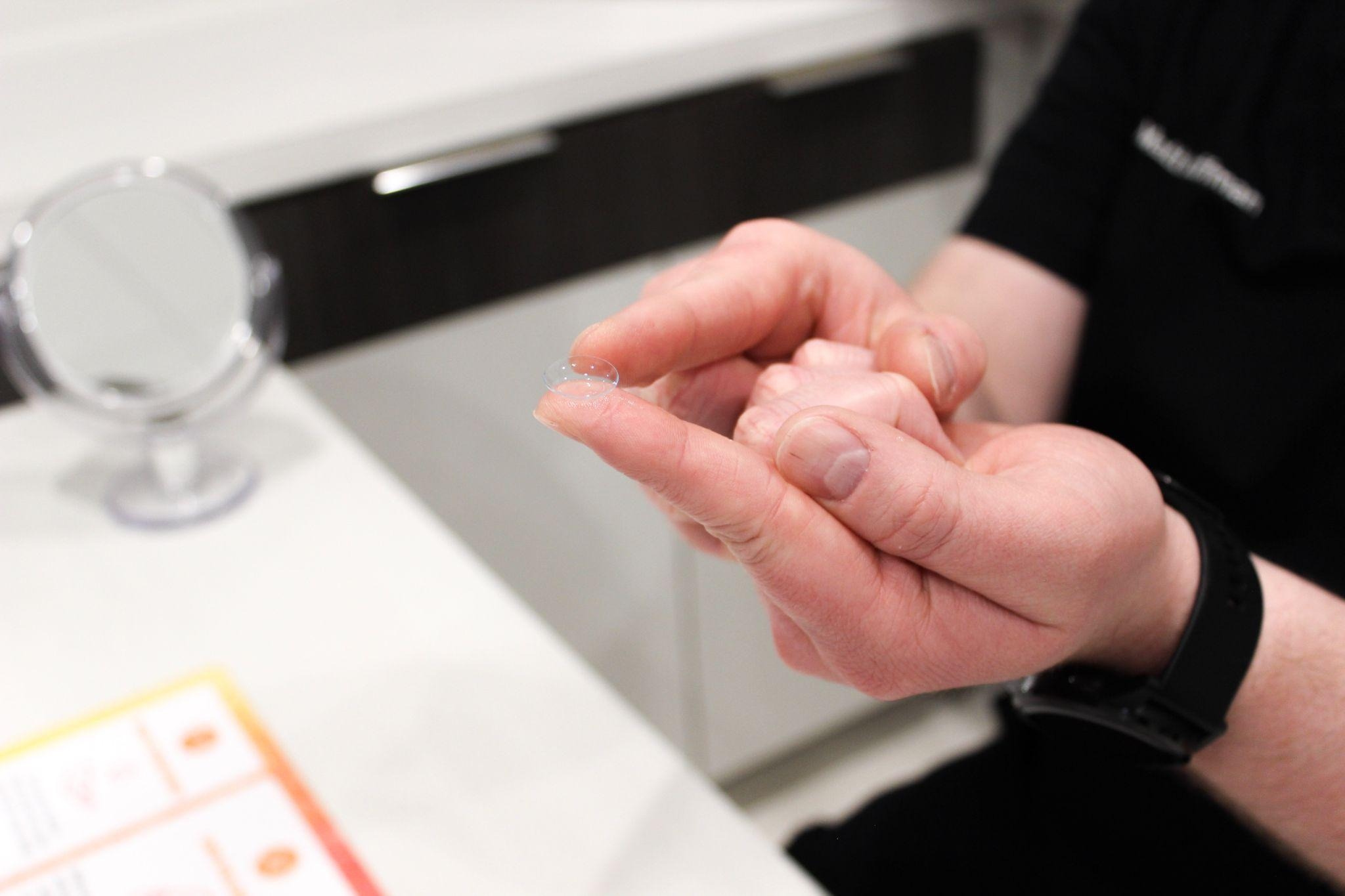
Almost every contact lens wearer has experienced it: by 4:00 PM, your eyes feel heavy, slightly gritty, and you find yourself blinking rapidly just to clear your vision. This is often referred to as lens fatigue.
In a healthy eye, a continuous film of tears lubricates the cornea and delivers vital oxygen. When a mass-produced soft lens sits on the eye, it relies heavily on your natural tear volume to maintain its flexible structure. If your tear production dips due to staring at digital screens, environmental factors, or underlying ocular surface imbalance, the lens begins to dehydrate, leading to friction against the eyelid.
The Modern Comfort Upgrades
To solve this without reverting to glasses, advanced care focuses on changing the material science and structural relationship of the lens:
- Hyper-Oxygen Permeable Polymers: Modern specialized soft materials allow significantly higher rates of oxygen to pass through to the cornea, preventing the metabolic fatigue that causes red, bloodshot eyes at the end of the day.
- The Fluid-Shield Barrier: Advanced diagnostic technology allows for the design of lenses that completely isolate a sensitive or dry cornea behind a continuous, self-contained fluid bath. By preventing the eyelid from rubbing against dry spots on the eye, comfort is instantly restored, even in challenging environments.
When Standard Vision Correction Reaches Its Limits
A standard vision prescription treats the eye as a perfectly uniform, smooth sphere. For many individuals, however, the surface of the eye features micro-irregularities, structural steepening, or structural asymmetry.
If you have been diagnosed with an irregular corneal profile, you may notice that standard soft lenses give you “shadows” around text or a persistent ghosting effect that never quite goes away, no matter how many times the prescription power is adjusted.
The Mechanics of Rigid Optics
To eliminate these specific optical distortions, specialized design utilizes firm, shape-retaining materials. Rather than conforming to the microscopic dips and curves of an uneven eye, a rigid optical surface creates a completely fresh, uniform front boundary for light to enter.
Because the lens maintains its structural integrity with every blink, light is refracted precisely to a single focus point on the retina. This specialized approach is what allows individuals who experience distorted vision from structural changes to achieve a level of visual sharpness that is often impossible to capture with standard glasses or flexible soft lenses.
Tailored Vision for Distinct Phases of Life
Our visual needs change dramatically as we age, and modern lens technology has evolved to address these specific milestones without forcing you into frames.
Seamless Visual Transitions for Adults
As the natural lens inside the eye becomes less flexible over time, focusing on close-up tasks or reading fine print becomes increasingly difficult. While many people turn to over-the-counter reading glasses or progressives, advanced lens engineering utilizes concentric or aspheric zones of varying focal powers. This allows your visual system to naturally select the correct focus whether you are looking at a dashboard, a computer monitor, or a smartphone, eliminating the constant need to search for a pair of readers.
Protecting Developing Eyes
For children experiencing a rapid increase in distance blurriness year after year, vision care is no longer just about updating a prescription. Specialized optical designs worn either during the day or overnight can alter how light focuses on the peripheral edges of the retina. This specific optical shift sends a biological signal to a child’s developing eye, actively discouraging the structural elongation that causes vision to worsen over time; safeguarding their ocular health for the future.
Navigating Your Next Step
If you are currently experiencing fluctuating vision, persistent dryness, or have been told in the past that your eyes are simply too difficult to accommodate, remember that technology moves forward rapidly. A specialized evaluation looks past standard dimensions, utilizing detailed mapping of your eye’s unique architecture to determine exactly what type of material, edge design, and vault will optimize your daily comfort.
To learn more about tailored visual design or to explore the differences between standard and custom options, view our comprehensive Specialty Contact Lenses Page or reach out to our team at (281) 697-5400 to discuss a dedicated evaluation.